Two Hearts, a Mouth, an Eye
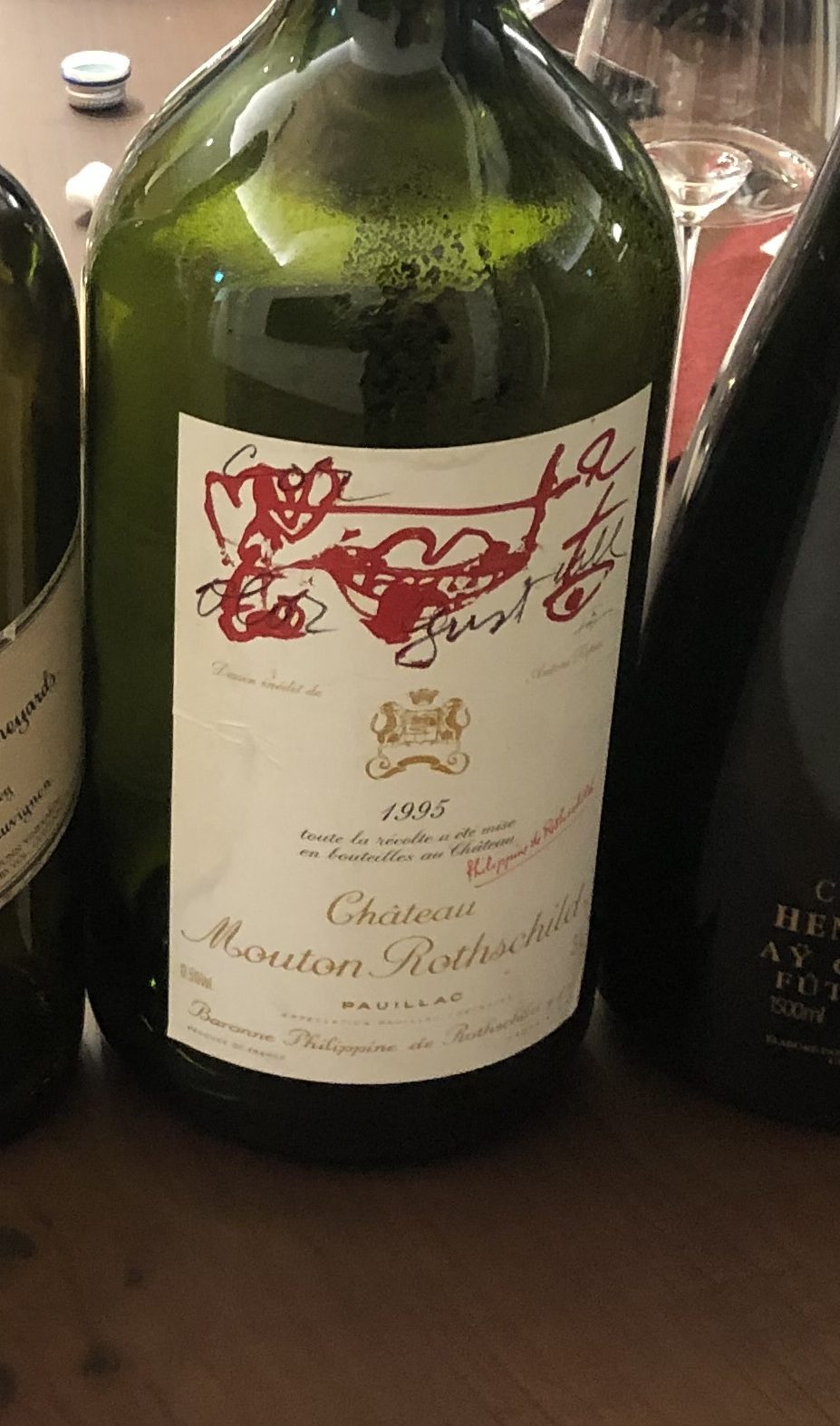
Château Mouton Rothschild 1995 (Large Format)
- Producer
- Château Mouton Rothschild
- Appellation
- Pauillac
- Grapes
- Cabernet Sauvignon, Merlot, Cabernet Franc
- Tasted
- 28 November 2020
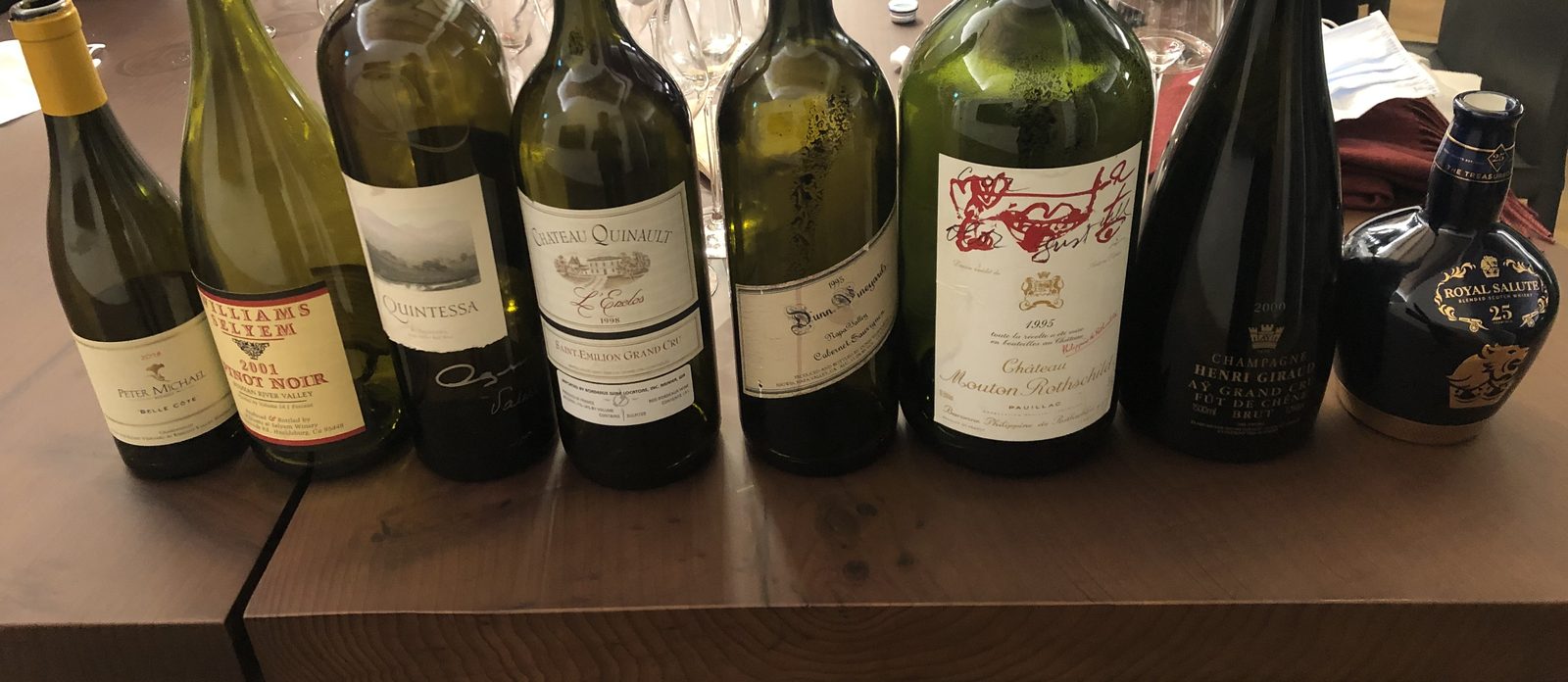
At the end of the evening the bottles were lined up along the table, to be looked at rather than poured. Seven of them, plus a decanter of whisky at the far right, and one that did not belong to the same scale as the rest.
Château Mouton Rothschild has commissioned an artist for its label every year since 1945, and the 1995 was given to Antoni Tàpies, the Catalan painter and sculptor who spent almost his whole life working in and out of Barcelona. What he sent was almost nothing: a few scarlet strokes and a scatter of black annotation. Look at it for a moment and the strokes resolve into a nose, a mouth, an eye, and two hearts — the senses laid out as a list, drawn with the speed of someone signing a receipt. Among the Mouton labels it is one of the least decorative and one of the most direct.
The Vintage Behind the Label
1995 in Bordeaux was a year of two halves. The winter and spring were generous with rain, which refilled the water table; then June, July and August were among the hottest and driest in four decades, and the vines went into real drought. Rain returned between roughly the seventh and the nineteenth of September, which was awkward for the Merlot and brought the Cabernet Sauvignon harvest forward.
The left bank came out of that sequence with fruit that was ripe but not soft, and Pauillac in particular had both quality and quantity. The wines were built on tannin, and for a long time they were described as tannic to a fault — classical, a little austere, more admired by drinkers who like Bordeaux to make them wait than by those who want it to open its arms. Mouton’s 1995 was assembled from 72% Cabernet Sauvignon, 19% Merlot and 9% Cabernet Franc, with the great majority of the harvest going into the grand vin.
The Question of Size
Set beside its neighbours the bottle answers a question before anyone asks it. The champagne to its right is a magnum and carries the volume on its label; the Mouton stands taller than it and is noticeably broader through the shoulder. A format like that does two things to a wine of this kind. It slows everything down, because the ratio of wine to the small amount of air under the cork is far more favourable than in a standard bottle. And it settles the character of the evening, because a bottle that size is not opened for two people.
Twenty-five years is roughly where a 1995 Pauillac stops being a promise. The fruit had gone from fresh to preserved — cassis turned dense and slightly candied — and underneath it the register the vintage is remembered for: truffle, coffee, liquorice, sweet spice. The tannins were still substantial and still chewy, holding the wine upright rather than getting in its way, and the acidity sat lower than in the tighter, sterner 1996, which made this the more immediately generous of the pair. In large format, at that age, it was neither young nor finished. It was simply arriving.
There is a version of this wine, in a normal bottle, that would have been drunk five years earlier and remembered as good. This was the other version.
For Bordeaux of neighbouring vintages from this archive, see Château Haut-Brion 2001 and Château Troplong Mondot 2004.