Where Rousseau Spares the Oak
Domaine Armand Rousseau Charmes-Chambertin Grand Cru 2011
- Producer
- Domaine Armand Rousseau
- Appellation
- Charmes-Chambertin Grand Cru
- Grapes
- Pinot Noir
- Tasted
- 29 October 2024
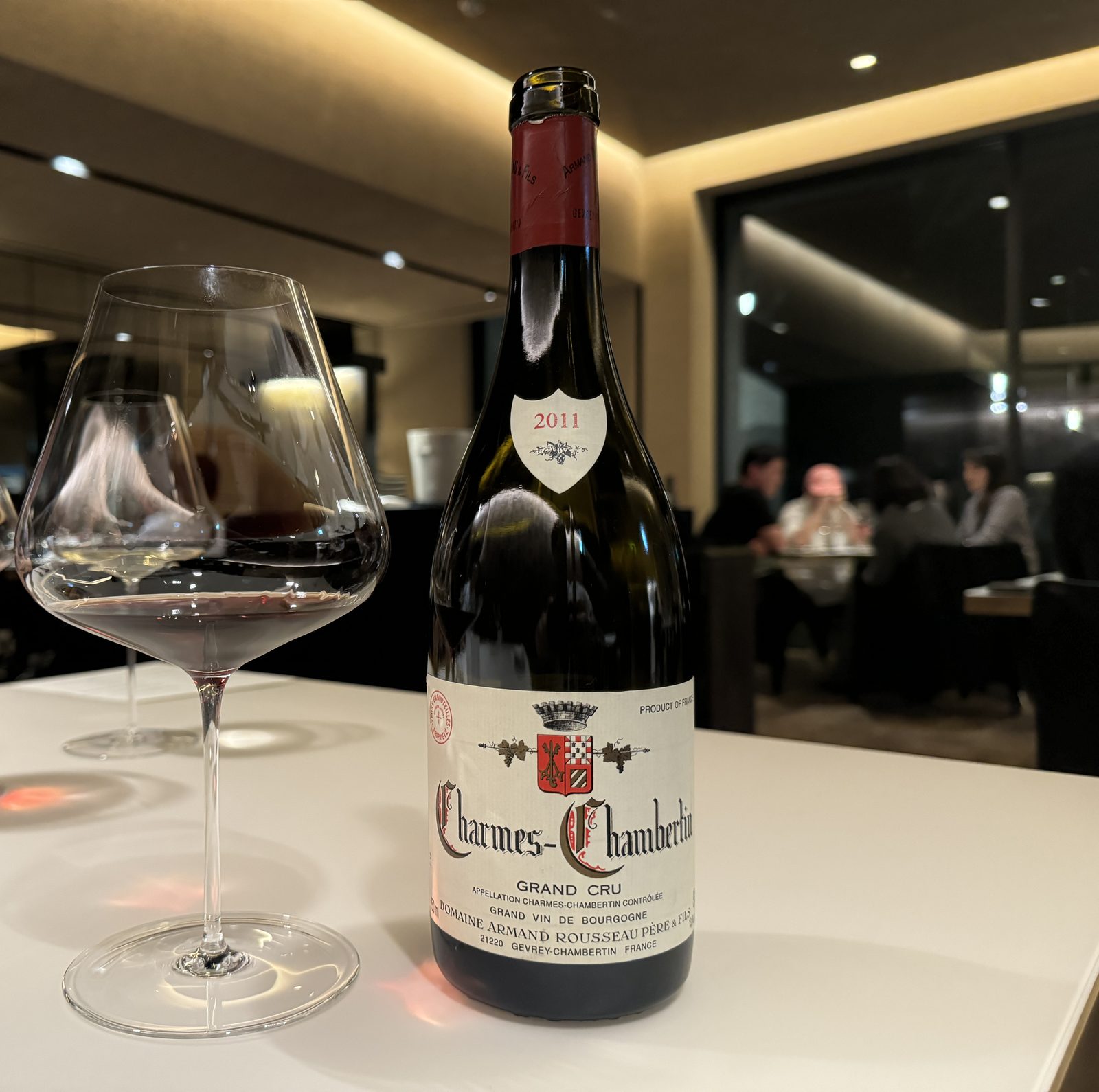
Talk of Domaine Armand Rousseau tends to orbit Chambertin and Clos de Bèze, but the house’s hierarchy is drawn twice — once in the vineyard, and once again in the barrel cellar. The top crus — Chambertin, Clos de Bèze, Clos Saint-Jacques — are raised in eighty to one hundred percent new oak. Charmes, along with the rest of the range, sees mostly one- and two-year-old casks. The wine is not treated as a lesser Chambertin; it is designed from the outset to be something else — the most fruit-forward, transparent, elegant expression in the Rousseau line.
There is a second quiet irony on the label: much of Rousseau’s “Charmes” — around sixty percent — actually grows in the neighbouring Mazoyères climat, which has the legal right to call itself Charmes. Burgundy’s paperwork, as ever, tells only most of the story.
The domaine itself is one of the region’s founding legends. Armand Rousseau inherited his first vines in 1902 at eighteen, and in the 1930s — on the advice of the editor of the Revue des Vins de France — took the then-radical step of bottling and selling under his own name rather than through négociants. Three generations later, the estate holds 8.5 hectares of grand cru out of its fifteen.
A Light Year, Worn Well
2011 was a featherweight vintage: an early spring, a late-June heat spike, then a cold, hail-marked July. Alcohol, tannin and acidity all settled at low ebb together, producing reds of transparent red fruit rather than grandeur — with the Côte de Nuits clearly ahead of the Côte de Beaune.
In the Glass
At thirteen years, spice and minerality led, with dark cherry, raspberry, violets and a peppercorn accent behind. Medium-bodied and unforced, but with a concentration and focus a clear step above the vintage’s average; the tannins made themselves known on the finish, signing off with a slightly angular, saline edge. The tertiary register — forest floor, leather, spice — was open and speaking.
2011 was never a vintage for long keeping, and this bottle sat comfortably inside its drinking window. The great years of Rousseau ask for patience and ceremony. The light ones, like this, simply ask for a glass — and they are often the ones you reach for.