A Queen for an Excuse
Rare Champagne Millésime 1988 (Piper-Heidsieck)
- Producer
- Rare Champagne (Piper-Heidsieck)
- Appellation
- Champagne
- Grapes
- Chardonnay, Pinot Noir
- Tasted
- 12 August 2026
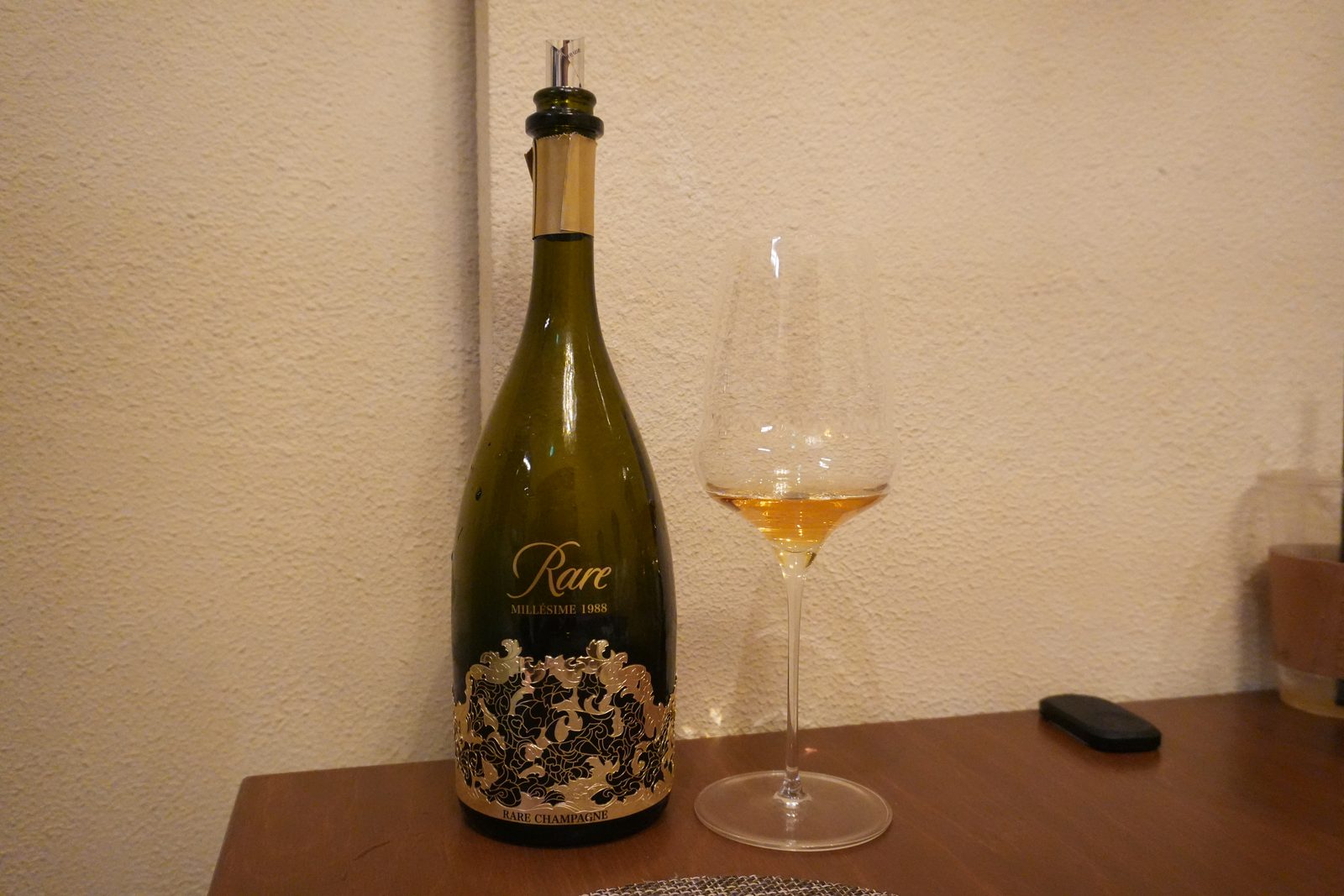
The evening was meant to be about Italy — a run of Piedmont and Veneto bottles lined up in a row. It opened, as these evenings often do, with something from Champagne instead: Rare 1988.
Rare is the cuvée Piper-Heidsieck reserves for years it considers out of the ordinary. The first vintage was 1976, and it did not reach the market until 1985 — a date chosen with some care. In 1785 the house’s founder, Florens-Louis Heidsieck, is said to have presented his Champagne to Marie Antoinette, and the debut landed exactly two centuries later. Whether one calls that marketing or devotion, the timing was not an accident. Since then the name has been used sparingly: across four decades, only a dozen or so vintages have carried it.
The bottle itself is hard to mistake. Around its base runs a gilded arabesque, a tiara designed by the Parisian jeweller Van Cleef & Arpels. It sounds like too much on paper. In hand it is quieter than it sounds — black glass, a band of gold, and nothing else shouting.
Then there is the year. 1988, 1989 and 1990 are usually discussed together as a trio of fine Champagne vintages, and of the three, 1988 is the taut one — the most structured, the highest in acidity, the slowest to relax. It is still common to hear that 1988s are young. That is a strange thing to say about a wine approaching forty, and yet the glass tends to agree.
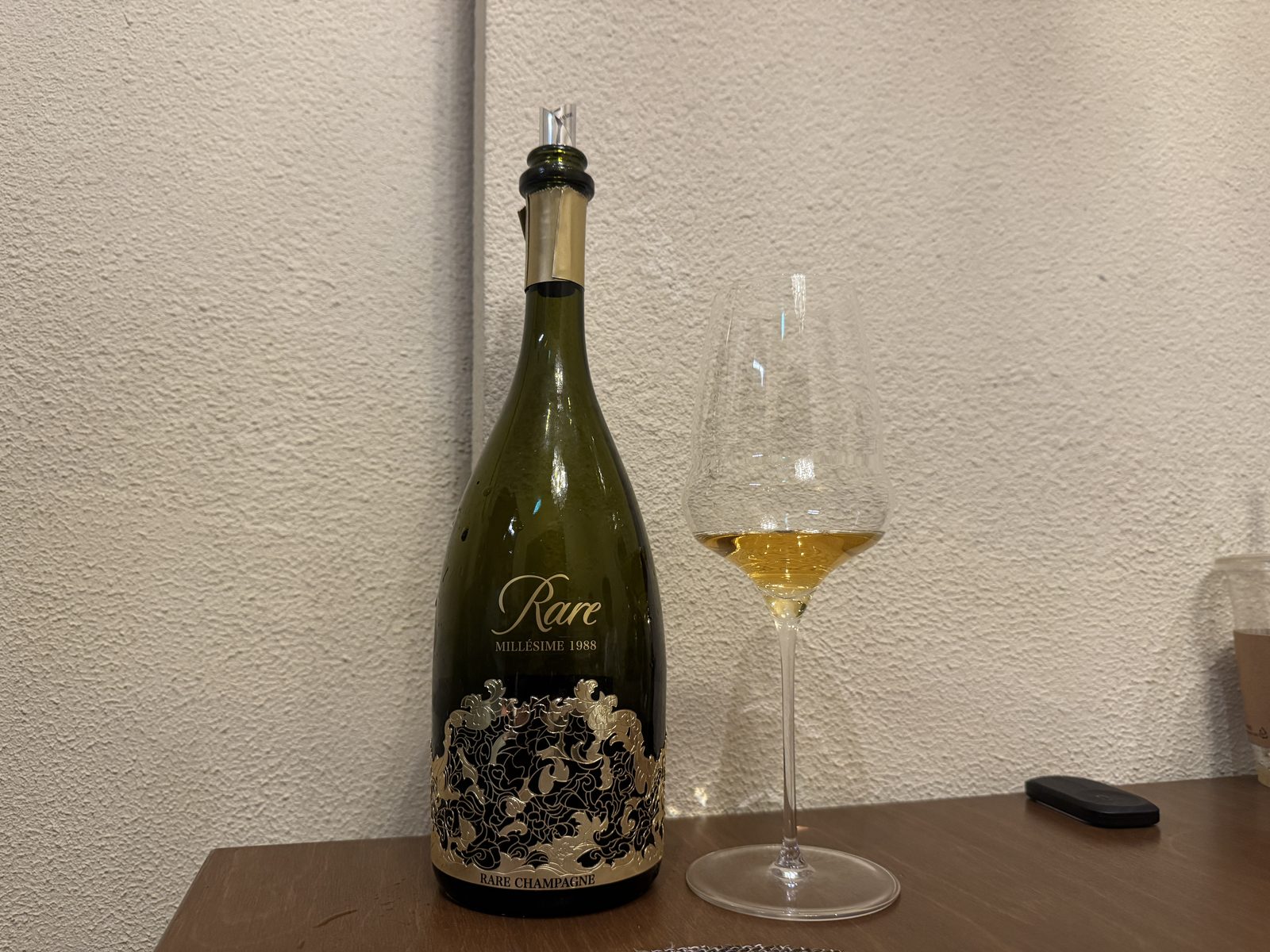
Deep gold with a hint of amber; the mousse reduced to something fine and almost silent. The nose starts with nuts and brioche, picks up cinnamon, and after some minutes in the glass turns toward dried grass and forest floor — the particular scent of Champagne that has grown old with grace rather than simply grown old.
On the palate it had more weight than I expected. Ripe fruit lies underneath, rounded and soft, but the acidity runs straight through the middle and keeps it from sagging. The finish is long: apple and honey first, then a saline, chalky note that outlasts everything else.
This is a bottle in a good place — fully open, not yet fading. With 1988’s backbone it does not need to be hurried, though at this age the condition of the individual bottle matters more than any general rule. As an overture to an Italian evening it may have been slightly grand. It did not feel that way once it was poured. The same cuvée from a warmer year, the 2002, is elsewhere in this archive.